
-
Norwegian Air Force Shirt
Regular price €40,00 EURRegular price -
Norwegian Desert M/03 Shirt
Regular price From €80,00 EURRegular price -
Norwegian M75 Jacket
Regular price From €50,00 EURRegular price -

 Sold out
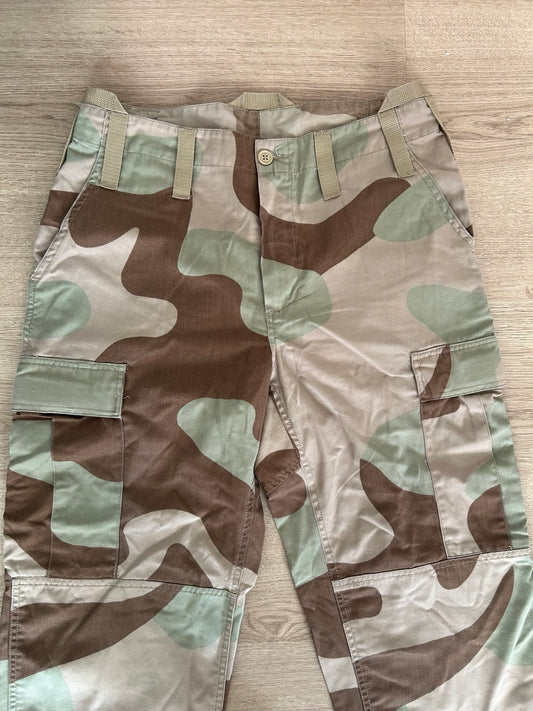
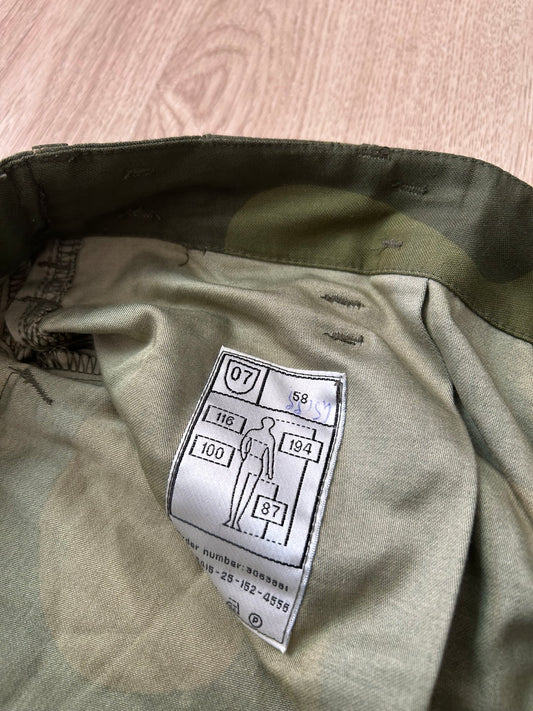
Norwegian Desert M/03 Pants
Regular price €80,00 EURRegular price -

 Sold out
Norwegian M98 Pants
Regular price €80,00 EURRegular price -
Norwegian M98 Shirt
Regular price From €50,00 EURRegular price



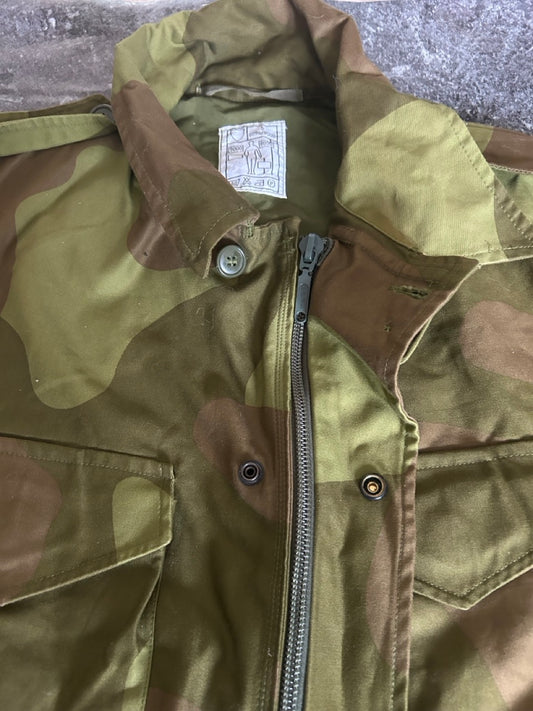


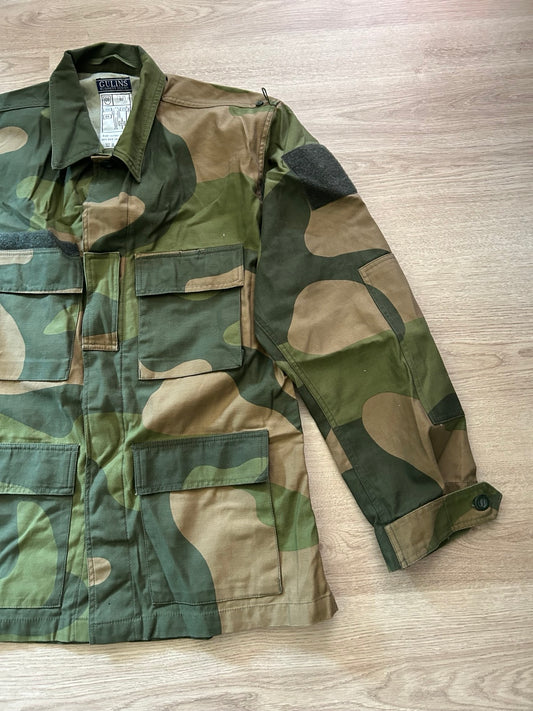
From the 1970s onward, Norway has used a small family of related camouflage patterns rather than constantly reinventing them. Each design reflects the country’s forests, mountains and winter landscapes, forming a clear lineage that evolves without losing its identity.
M75 Woodland
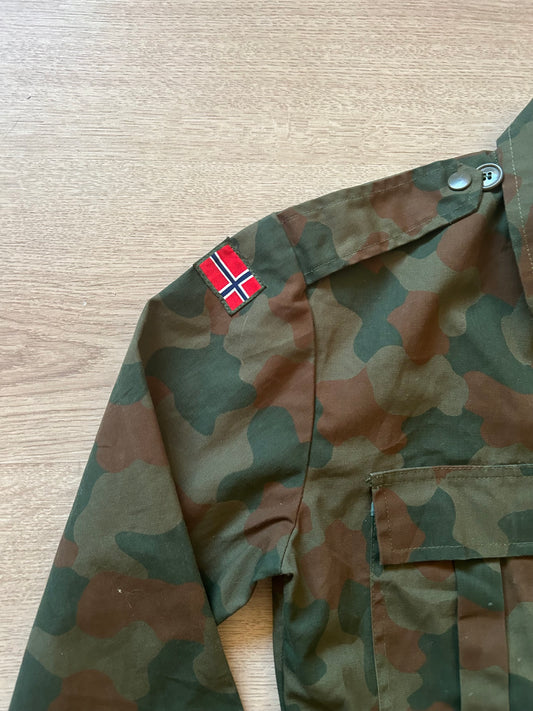
Introduced in the mid 1970s, M75 was Norway’s first widely issued national camouflage pattern and was designed specifically for dense Scandinavian woodland. It uses large rounded shapes in dark green, medium green and a khaki tan base, giving strong contrast suited for conifer forest, rock and moss. Early on it was common to see a smock in M75 worn with plain green trousers, a practice later replaced by full matching sets.
M98 Woodland
Around 1998 Norway updated the basic field uniform to M98, which kept the familiar three color woodland concept but adjusted the shapes and tones. The pattern still uses dark olive green, yellow green and tan, though the brighter palette and tighter shapes reduce the dark silhouette produced by M75. The uniform cut was modernized with cargo pockets, Velcro name tape and a matching jacket and trousers, becoming the standard combat dress for the Army, Air Force and Home Guard. M98 served through the late 1990s into the 2010s and became the most recognizable Norwegian uniform of the modern era. Despite being one pattern, it is common to see significant color variation between different production years and manufacturers.
M03 Desert Pattern
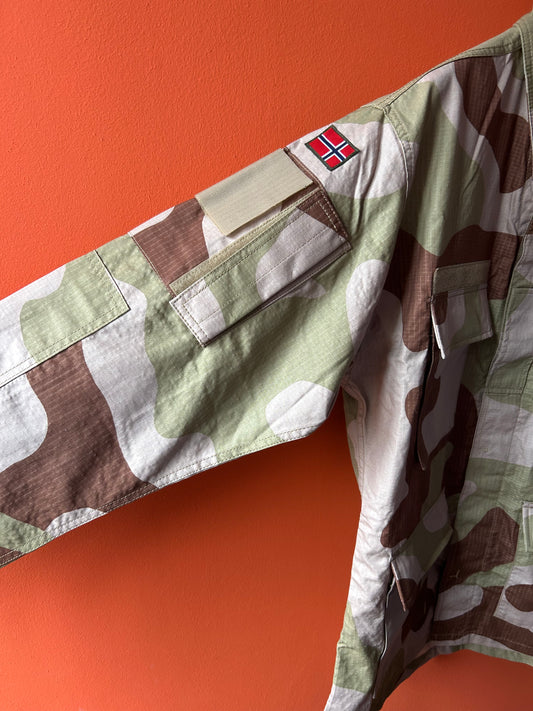
With deployments to Afghanistan and Iraq, Norway adopted a dedicated desert variant known as M03. It keeps the flowing Norwegian shapes but replaces woodland tones with light green, medium brown and dark brown on a sandy base. The uniform cut follows the M98 style, making the color palette the major difference. M03 was used in arid and semi arid environments where standard woodland camouflage was too dark.
M04 Woodland (Ripstop Update)
Feedback from troops highlighted that M75 was often too dark and M98 sometimes too light. In 2004 Norway introduced an updated woodland iteration, commonly called M04, which kept the general layout of M98 but used ripstop fabric and adjusted coloration to strike a better balance for Scandinavian terrain.
Snow Camouflage Over Suits
With large parts of Norway covered in snow during winter, white camouflage over garments have long been part of the kit. Traditionally plain white, newer versions add subtle grey elements to mimic shadows, dirty snow and exposed rock. In the NCU system the snow jacket and trousers form part of the issued ensemble, with the updated pattern offering more realistic winter concealment.
M23 Nordic Combat Uniform (NCU) Pattern
The most recent development is the M23 uniform, Norway’s implementation of the NCU system that began fielding in 2025. The layered system includes base layers, combat jacket, trousers, insulation and rain gear, along with a new national camouflage pattern. This design builds on M98 but uses more mottled shapes and refined colors, tested to reduce detection better than older patterns. It is visually denser and more complex, optimized for forest, scrub and rocky terrain while remaining distinctively Norwegian.
Special Use and Mountain Patterns
Norway has also explored specialized camouflage for certain terrains. A modern mountain pattern is used by Army and Home Guard units, featuring a complex photorealistic design suited for rock, scrub and highland terrain. Special operations forces have mixed national patterns with commercial multicam type uniforms depending on mission needs. Officially, the lineage runs from M75 to M98, then to desert variants such as M03 and now the modern NCU M23 system.